In Germany, legal fees for attorneys are primarily governed by a statute known as the Rechtsanwaltsvergütungsgesetz (RVG), or Law on the Remuneration of Lawyers. This law sets out the fees that lawyers may charge for specific legal services — both in and out of court — unless the parties agree otherwise in a fee agreement.
1. Fee Calculation Based on the “Gegenstandswert / Streitwert” (Value in Dispute)
For most out-of-court legal services — such as drafting formal demand letters, negotiating settlements, or advising clients on enforceable claims — the legal fees are calculated according to the monetary value of the issue, called the Gegenstandswert (value in dispute). The higher the value of the matter, the higher the applicable fees.
Let’s take a simple example: if a client seeks to recover €10,000 in unpaid invoices, the fee is based on €10,000. The base fee for out-of-court services (1.3 Geschäftsgebühr) is then determined from an official fee table tied to this amount.
This system is intended to ensure a fair, predictable structure for legal costs based on the scope and legal significance of the case.
2. Default Values in Family Law and Non-Monetary Disputes (“Auffangstreitwerte”)
In cases where there is no specific financial claim, such as custody, visitation, or declaratory matters, the law provides for standard dispute values, also called “Auffangstreitwerte”.
For example:
- Divorce proceedings: Calculated as three times the net monthly income of both spouses combined.
- Custody or visitation disputes: Typically assigned a standard Streitwert of €4,000.
- Non-monetary civil law disputes: Often assigned values ranging from €1,000 to €5,000, depending on complexity.
These default values serve to standardize legal fees and ensure consistency across similar cases.
You can easily check the fees for out-of-court representation by using this tool:
https://anwaltsblatt.anwaltverein.de/de/apps/prozesskostenrechner
Just type in the in the box “Streitwert” ( #1 ) the amount in dispute.
and make sure the box “Außergerichtliche Vertretung” is checked (#2),
and you´ll see the fees (#3)
like this:
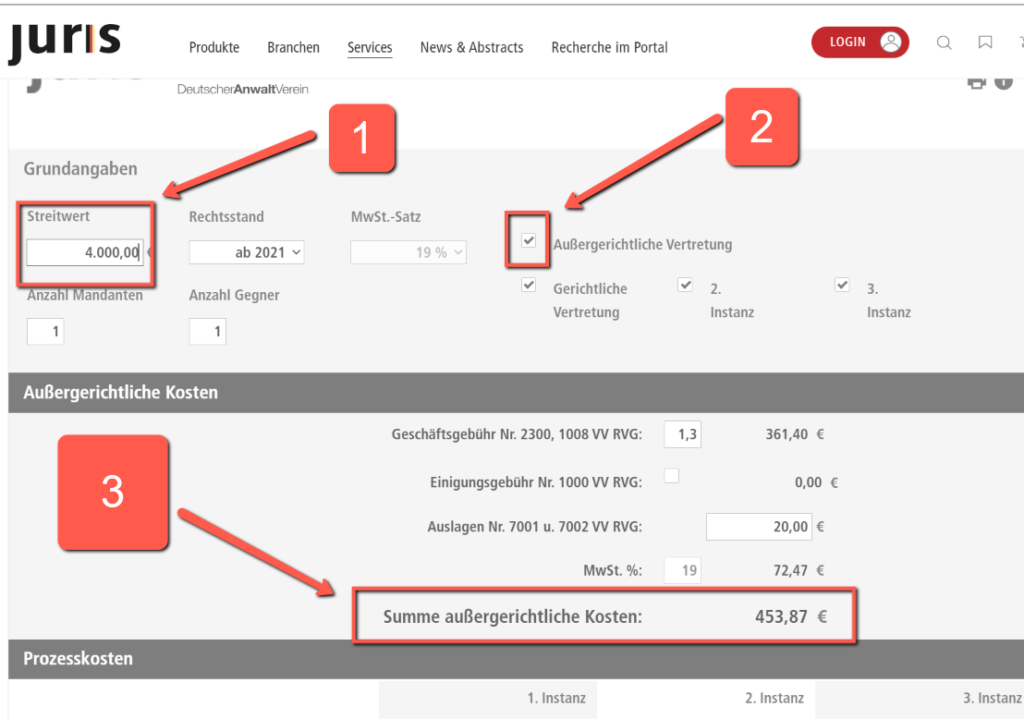
As you can see in the example above, given an amount in dispute of 4.000 Euro, the fees for the out of court representation (“Summe außergerichtliche Kosten”) are 453,87 Euro.
3. Additional Fees for Settlements
If an attorney’s out-of-court work results in a formal settlement (i.e. a binding agreement between the parties), the RVG allows for an additional fee — the “Einigungsgebühr” or settlement fee. This is usually 1.5 times the base rate and is meant to compensate for the additional time, skill, and effort required to reach a negotiated solution.
Even if no lawsuit is filed, the mere fact that the lawyer helps both sides reach a settlement agreement can increase the total fee.
In the example above, to figure out the fees for settlement, just check the box: “Einigungsgebühr Nr. 1000 VV RVG” (# 4) as indicated here:
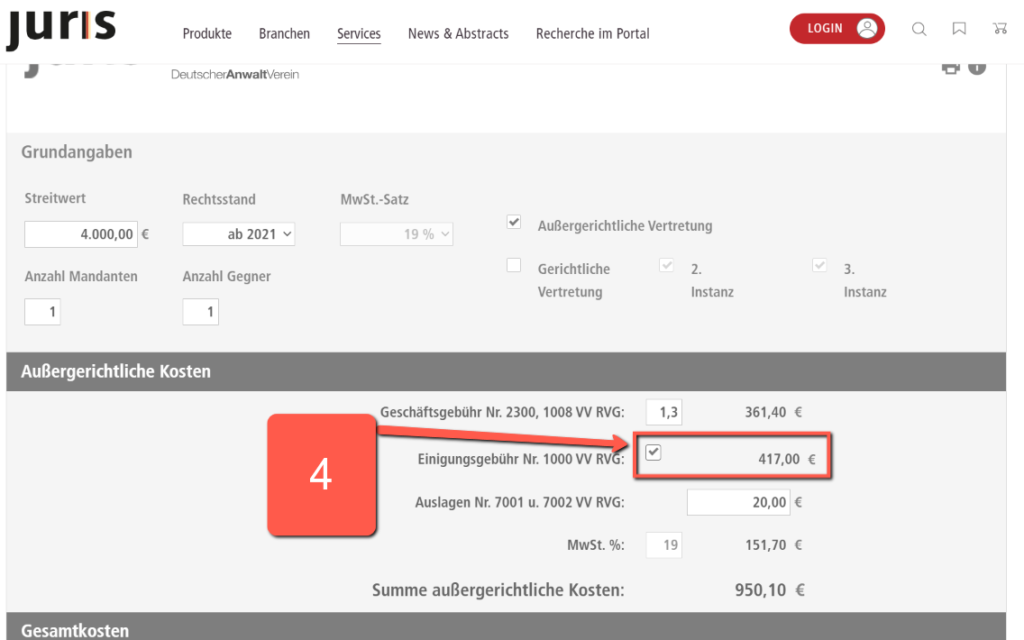
As you can see, if the case is closed by an out-of-court settlement, the legal fees (“Summe außergerichtliche Kosten”) are now 950,10 Euro – or roughly twice as much.
4. Typical Hourly Rates in German Law Firms
In some cases, particularly for business clients or complex individual matters, German lawyers may offer their services based on hourly billing, provided this is agreed upon in advance and in writing.
Typical hourly rates (as of 2025) are as follows:
- Small / regional cases: €180–€280 per hour
- Cases requiring specialist knowledge and experience: €250–€400 per hour
- Top-tier international or high-profile cases: €400–€700+ per hour
At our firm, we believe in fair and transparent pricing. That’s why our hourly rates are determined primarily by the client’s financial capacity and the complexity of the case.
- For financially vulnerable clients, such as individuals with modest income or those facing personal legal difficulties, our rates are usually set toward the lower end of the spectrum.
- For large corporations, high net-worth individuals, or complicated international commercial clients and transactions, our rates are calibrated toward the upper range, reflecting the complexity, urgency, and higher expectations typically involved.
This flexible approach allows us to deliver legal services that are both ethically responsible and economically realistic, ensuring access to justice without compromising on professional standards.
5. VAT and Services Rendered to Foreign Businesses
Under German VAT law, if the legal service is provided to a business client located in another EU member state, and that client has a valid EU VAT ID, then no German VAT will be charged on the invoice. Instead, the reverse charge mechanism applies, and the client is responsible for declaring and paying the VAT in their home country.
This applies, for instance, when a German lawyer represents a Romanian or Dutch company in collecting debt or handling civil disputes in Germany. However, the lawyer must verify the foreign company’s VAT ID before applying the reverse charge rule.
Summary
Legal fees for out-of-court legal services in Germany are:
- Statutory, unless otherwise agreed
- Based on the value of the case (or standard values when unclear)
- Increased if a settlement is reached
- Exempt from VAT for EU-based business clients under the reverse charge mechanism
If you’re considering legal action or simply want a lawyer to handle a negotiation, it’s essential to ask for a clear breakdown of fees upfront, including how the value in dispute is calculated. A good lawyer should also provide a realistic cost-benefit analysis before beginning any legal procedure.
Law Firm Kiril Stawrew